Monday, August 07, 2006

Grasshoppers

As the summer season progresses I notice changes in the plants and small creatures that I see along the trails and paths that I follow each day.

In July, most morning walks were interrupted by my stopping to take pictures of Skippers and Fritillaries; then Common Wood-nymphs, Monarchs, Painted Ladies and Viceroys appeared. Cabbage Whites and Sulphurs started alighting on vegetation long enough for me to catch their images with my camera; last weekend I saw a Milbert's Tortiseshell Then gradually I noticed changes. During the past couple of weeks I seldom saw Skippers anymore and fewer butterflies. However now I am often alerted with a dry, sharp "click-click" sort of sound and I see many flying dark wings with light borders crossing my paths. Grasshoppers. There seem to be many and they jump and fly about as I walk along . I don't know their special names but I do have a few pictures of them to share.

Saturday, August 05, 2006

Blueberries

Above is a photo taken on May 24/06 of Blueberry Blossoms. Alighting on the blossoms is a Spring Azure Butterfly.

Picking wild Blueberries was always an anticipated event for my brothers and I when we were children. Many were the early days in August when we would take our treasured little Blueberry picking pails and head out for locations nearby which we knew would provide a plentiful yield.
The Blueberry photo (above) was taken today, August 5th, at the edge of the meadow where I often take photos of butterflies in July.

Friday, August 04, 2006

Bonaparte's Gull (Larus philadelphia)

If you said Bonaparte, I would say "Napoleon"; and I often do for the word association plays tricks with my mind and whenever I see these little Bonaparte's Gulls I often initally misname them by calling them Napoleon Gulls.

After returning home yesterday and downloading my pictures I consulted my copy of, The Sibley Guide to Birds (David Sibley, 2000) to confirm their identification.

At first glance there were three smaller sized gulls with black heads to consider. I immediately ruled out Black-headed Gulls as they have orange-red bills and all of the gulls in my photos had black bills. I also ruled out Little Gulls. The black hood on a Little Gull is more extensive than a Bonaparte's Gull and the Little Gull, as denoted by its name is little; smaller than a Bonaparte's. Also Little Gulls are not that common in my area; especially not in large groups like the one I had seen yesterday.

The narrow black edging of the Bonaparte's wings in flight confirmed it's id to me. In this
photo above the black edging on the wings is very evident.

Wednesday, August 02, 2006

Black-capped Chickadee (Poecile articapilla)

" Chick-a-dee-dee-dee"

Tuesday, August 01, 2006

Common Mergansers (Mergus merganser)

editing note: the above photo was added on Aug. 4/06

There is an advantage to living close to a river if you have an interest in nature photography.

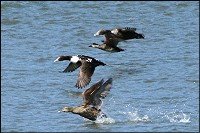
This afternoon while out walking I stopped at one of the river lookouts and saw six Common Mergansers swimming down stream. Seeing these Mergansers made me realize that they were the first I had seen this summer. This years spring and summer seasons have brought a lot of rain, resulting in very high water levels at times, and I had wondered if any ducks along the river had been successful in their nesting.

Later, while browsing through my picture files, I found I was able to document this Merganser species' presence on the river previous summers as early as June. Above is one of my favourites photos: a female Common Merganser and her young ducklings, taken in June, 2002.
Another photo (below), taken on August 15, 2001, shows these Common Mergansers at much the same stage in their development as the six that I had seen today. One year mergansers were still present on the river in November.
above: a male Common Merganser

Dragonflies at a Bog

Every time I pass by the spot along the roadside where the skeltons of trees are outlined against the sky I want to stop but often do not have the time. Yesterday, however, I did stop and stood at the watery edge of the bog and took a few pictures of the many dragonflies and a lesser amount of damselflies there.

The area over the water was full of darting movements. I found the Twelve-spotted Skimmers (see dragonfly with white and black spots on wings) fascinating as they hovered in mid air before darting away and landing on nearby perches. This species seemed to be most prevalent in numbers but as well there were many Four-spotted Skimmers there. (pictured below).

One Common Whitetail (see below with the white tail and brown upper body) seemed to have its own favourite area and would most always return to the same location. This species seemed fewer in number than the others and there may have only been the one.

I haven't tried to identify the damselfly species I saw but they all seemed to be similar looking and were blue.

Thursday, July 27, 2006

Tussock Moth & Tiger Moth Caterpillars

Nature always has fascinating surprises in store and sometimes I just laugh out loud when I am suddenly presented with one. And that's what I did when I first saw the White-Marked Tussock Moth Caterpillar. It looked something like a walking toothbrush that was badly in need of replacement.

Vincent Van Gogh often comes to mind when I see some of these surprisingly vividly coloured creatures (such as the red, yellow and orange of Painted Turtles) and now I would add the White- Marked Tussock Moth Caterpillar to my list for the yellow and reds of this creature are fascinating! Some of these caterpillars have yellow tufts instead of white. I have seen two in our yard within the past two days; one with yellow tufts and the other with whitish beige ones.

I have recently identified another Tussock caterpillar which I have had in my picture files since 2001 and that is the Spotted Tussock Moth. Although not classified in the same family as the White- Marked Tussock, it presents an attractive colour and design of its own and it has been one of my favourite caterpillar photos.

To the left is a Banded Tussock Moth. When retriving this photo from my picture files I realized I hadn't actually looked at it carefully before and had assumed it was a Yellow Bear until examining it closely today.

As a child, probably the only caterpillars I had noticed or could identify were Wooly Bear and Yellow Bear. Even today their names evoke a childhood recall of familiarity.

Wooly Bear, seen below in orange and brown, becomes an Isabella Tiger Moth and Yellow Bear, which looks much like Wooly Bear but is yellow, turns into a Virginian Tiger Moth.

Tuesday, July 25, 2006

Viceroy Butterfly Caterpillar

Finding something by chance and then later making a connection to something that is already known is always a satisfying experience.

I took a picture of a caterpillar yesterday which I found while standing on the graveled shoulder of an old country roadside taking photos of Common Wood-Nymph butterflies. It wasn't a beautiful looking creature but the simple fact that it was a caterpillar attracted me to it immediately.

I have recently bought a new field guide; Caterpillars of Eastern North America, by David L. Wagner, and since then I have been enjoying searching through the wonderful colour pictures included in the book identifying a few caterpillar photographs I had taken and stored in my picture files since 2000. To find a new caterpillar to research just added to my fun.

And so I anticipated the enjoyment of having one more new species to identify. I was very pleased when I easily found a match for my new caterpillar picture: a Viceroy Butterfly Caterpillar Limentis archippus

Friday, July 21, 2006

Bobolink (Dolichonyx oryzivorus)


The male Bobolink is an interesting contrast study of black and buffy white and is easily identified when seen in its habitat of choice; grassy meadows.

Although I don't see Bobolinks often, and when I do they are at a distance in a field or sitting on a fence; however, I did have an opportunity to study the male of this species up close in May, 2002, when one visited our feeder area. It was unusual to see a Bobolink in our feeder area and I was amazed and delighted to see one so close and to be able to study and capture a photo of the design of its back view up close.
Last weekend while stopping by a grassy meadow I was able to photograph two males together; as well as a male and female together in flight.

Wednesday, July 19, 2006

Monarchs (Danaus plexippus)


I had never been fortunate enough to find Monarch butterflies to take pictures of until this year.


I determined to remedy that and remembering the location of some Milkweed plants that I had seen last fall along a roadside just a short distance away; visited that location. I found two Monarchs feeding there and also saw my first Monarch caterpillar!

The next week I located a larger growth of Milkweed alongside another roadside . And at this location there were several butterflys including Monarchs, Great Spangled, Aphrodite and Altanis fritillaries. And as an added bonus I found several Clear-wing Hummingbird moths, a couple of new skippers that I hadn't photographed before: Peck's Skipper and a Dun Skipper. Also a very beautiful American Copper in a closed wing position.

Returning to that second roadside area just a day ago the Monarchs and fritillaries that I had seen before were gone and instead Common Wood-nymph were in abundance. Having thought that perhaps I had seen my last Monarch of the summer I was very pleased to find a beautiful one feeding in my flower garden yesterday afternoon.

Tuesday, July 18, 2006

Northern Leopard Frog (Rana pipiens)


I had forgotten that not all frogs live in ponds or watery areas and so was very surprised yesterday to see a Leopard Frog in my garden. Upon doing some research I find that this species prefers to live in grassy or cultivated areas.

Leopard Frogs are usually from three to four inches in length and have interesting looking brown spots with light green outlining them. This frog had a nice 'grassy green' colour overall. The two ridges on this frog's back was really noticable.

Sunday, July 16, 2006

Spotted Sandpiper (Actitis macularia)


This Spotted Sandpiper was making quite a racket when I was walking along the river shore the other day. I had gone searching to see if Cardinal flowers were in bloom and all of a sudden I heard. "Peep, peep, peep, peep". (sandpipers are often referred to as 'peeps')

Usually a sandpiper will fly away when approached but this one obviously had young nearby and was loudly warning them to stay where they were. At times it even got closer to me creating a better opportunity to take pictures.

Friday, July 14, 2006

Raccoons

This masked bandit is often a nightly raider of our bird feeders. We know when Raccoons have visited during the night for in the morning we see the signs; the feeders have been emptied. On occasion we see a Raccoon during the daytime but usually they only visit after dark.

This little Raccoon, to the upper right, seemed to be a young one for it was quite small and visited in the daytime one day in May and stayed in our feeder area for quite a while.

Tuesday, July 11, 2006

White-tailed Deer


White-tailed Deer are frequent visitors to our gardens. These beautiful, graceful creatures come sometime during the night or early dawn and munch away at our Phlox and Hosta plants; as well as other plants too. Evident in the morning are often hoofprints in the soil and a chewed plant. We stopped having a vegetable garden a couple of years ago as it just wasn't worth the work; now we grow tomatoes in pots and that is the extent of our food growing endeavours. Deer love cedar as well and a few years ago several spent one winter munching contendly on our hedge.

Some years there is more activity around our yard than others. Once visitors from the west kept hoping to catch a glimpse of a White-tail before they returned home but it not happen. However, about an hour after their departure we counted eight deer on our side lawn that morning. That really is a lot and not a usual number for us to see. In fact I haven't seen a deer in our yard for a long time but I know when they have been there by viewing the remnants of some plants in the morning.

I snapped a picture of these three deer feeding along the roadside in May of this year. Seen below is a male White-tailed Deer; a buck. This picture was taken from my car window.


A fawn (below), a young White-tailed Deer ventured onto our property last summer and stayed long enough to have its photo taken.