Friday, November 17, 2006

American Widgeon

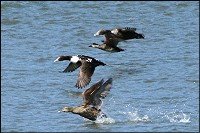
When I first started birding I could identify very few duck species just by sight. Even though I might sight several different species all at the same time, most of them would have flown away before I could find their id in my bird guide book. It took more than one season for me to gain the ability to scan a group and be able to list the different species at a glance. However, when I spied some American Widgeon last weekend among a group of Mallards and Black Ducks no field guide book was necessary to id them. The warm brownish colouring of the body and the white crown and flanks of the male Widegon are easily noted identifiable visual characteristics of this bird. Also the shading around the eyes of these ducks makes me think they are wearing 'eye shadow.'

Thursday, November 16, 2006

female Mallards

The colour of blue on the Mallard's wing reminds me of the blue in the Dress Buchanan Tartan.

Wednesday, November 15, 2006

American Black Duck x Mallard Hybrid


(photo above of a male Mallard and a female American Black Duck)
While observing a large group of Mallard Ducks yesterday I also noticed a few American Black Ducks among them. I then saw one duck which had a few charactistic features of both species. This was an American Black Duck x Mallard hybrid; (see photos above right and below)the result of an Amercian Black Duck and a Mallard breeding.
reference source: The Sibley Guide to Birds; by David Allen Sibley, p-83

Tuesday, November 14, 2006

Cattle Egret


This Cattle Egret photo (above) was taken this weekend past in Saint John, NB on November 12th. The only other time I had seen a Cattle Egret in New Brunswick was on October 21, 2001 at Sheffield. At that time I was quite distant from the bird and didn't have the opportunity to get many details of the egret up close. However, it was fun to capture both the Cattle Egret and Cattle in the same shot.

Saturday, November 11, 2006

Chipping Sparrow Still Here


They arrive every April, during the latter part of the month and stay around our feeder area until late October or early November.
I have no sighting records of them here in Nov. 2005 however
- in 2003 my last sighting of them was on Nov. 4th
- in 2002 on the 3rd
- in 2001 they were gone by November
- in 2000 they left on the 3rd.
In 2006, as of yesterday, November 10th, one is still here! This is the latest in the fall season that I have seen these little Chipping Sparrows at our feeders.

Tuesday, November 07, 2006

female Red-winged Blackbirds


Our first snow came yesterday and with it came a small flock of Red-winged Black birds , stopping for a while to feed before continuing their flight to more southern regions. Female Red-winged Blackbirds had been a mystery to me when I first noticed them at our feeders a few years ago; at first I did not know what they were for they looked so different from their male counterparts. Yesterday both male and female Red-winged Blackbirds were at our feeder area.

to view a posting on male Red-winged Blackbirds go to:http://naturetales.blogspot.com/2007/03/male-red-winged-blackbird.html

Monday, November 06, 2006

American Tree Sparrows

These little northern sparrows, American Tree Sparrows, arrived at our feeders last week. Tree Sparrows breed from Alaska to northern Labrador and then migrate to more southern areas to winter. I wait for them to return every year around this time and they have become a seasonal marker for me; bringing with them the expectation that snow and cold weather, which heralds the beginnings of winter, will soon follow. The little dark spot in the center of their breasts easily separates them from other sparrows. Another identifying feature is their yellow lower mandible, the lower part of their bills.

Sunday, November 05, 2006

Red Crossbills


At first when I saw this small flock of birds in the sunlight, gathered on the dirt road ahead of us, I thought they were a group of Goldfinch. My first glance had seen the yellow and greyish colouring and I almost drove on but then I also caught a glimpse of red. A male Red Crossbill! And a closer look told me that the yellowish birds that I had thought were Goldfinch were actually juvenile and female Red Crossbills. Crossbills get their name from the crossed positioning of their bills and this photo close up to the left of a juvenile Red Crossbill shows this feature quite well quite well. It isn't often that Crossbills visit feeders but Ihave included two pictures below of ones that did sometime around 2003. The first is of a male Red Crossbill and the last photo is of a White-winged Crossbill.

To view other postings on Red Crossbills please go to:
http://naturetales.blogspot.com/2007/03/adult-female-red-crossbill.html
http://naturetales.blogspot.com/2007/03/male-red-crossbill.html

Saturday, November 04, 2006

Cedar Waxwing


Another masked visitor; but this was a welcome one. This handsome Cedar Waxwing visited our feeder area this week and checked out the remaining supply of crabapples on our Flowering Crabapple tree.

Friday, November 03, 2006

juvenile Robin


I've never seen a juvenile Robin this late into the autumn season but the few lingering spots on this birds rusty breast suggests to me that this is a young Robin. It was perched in our Flowering Crabapple tree this morning; then it dropped to the ground below and fed briefly before it flew away.

Thursday, November 02, 2006

Nightly Visitors


On Hallowe'en night we treated over a hundred welcome visitors, however there are a couple of persistent masked visitors that have worn out their welcome long ago! Usually night time visitors, last week I watched from my window as two Raccoons checked out our feeder area during the afternoon. However they did provide a good photo opportunity and I took a few pictures before we sent them on their way.

Tuesday, October 31, 2006

Canada Geese


Monday, October 30, 2006

Ring-billed Gull


A lot can be added to a person's knowledge of identifying character- istics of birds at their various life stages through studying details in photos. A good example of this is the comparision of details from a couple of photos that I had taken on the weekend of a 1st winter Ring-billed Gull and an adult nonbreeding Ring-billed Gull. Noting the difference in leg colour of these two gulls; the younger gull shown above has pink legs and the adult to the right has yellow ones. The ring positioning on the bill also is different. The black ring on the 1st winter gull's bill extends to the tip while the mature bird's shows the ring further up on the bill. The bill colour is different too; the younger gull's bill is pink and the adults is yellow.
.

Saturday, October 28, 2006

Partridge in Tree


Ruffed Grouse/Partridge photo November 2003

Ruffed Grouse


This Ruffed Grouse, known also as a Partridge, was sitting on a log under our High Bush Cranberry tree yesterday afternoon. This is the time of year when I often check along roadside birch trees on sunny days hoping to catch a glimpse of one feeding in the trees; for that method has most often been my sighting experience. Being able to photograph this Grouse from my living room window was a pleasant surprise.
An earlier photo (November 2002) of a Ruffed Grouse illustrates how well its colours allow it to blend into a fall landscape.

Thursday, October 26, 2006

juvenile Great Blue Heron

This juvenile Great Blue Heron, seen in the photo to the right, could well be my last Heron sighting this fall as the season is now getting late. I think this most recent photo of Oct. 23 creates an interesting seasonal balance with the first Heron photo of the year that I had taken in April. In this early spring photo the Heron is flying across a drab spring landscape and in this most recent October picture the landscape is again returning to that of dormancy.

Tuesday, October 24, 2006

Gray Jay

It isn't often that I see a Gray Jay (also know as as Canada Jay, Wiskey-Jack) but if I do it is usually at this time of year that I catch a glimpse of one of these coniferous forest birds. Yesterday I enjoyed that oppor- tunity. I saw it's approach through the near leafless trees alongside an old dirt road and I stopped my car and watched its pattern of ' fly and perch' movements between the roadside branches. It would take a short flight to another tree and then briefly stop before continuing on to another. As I stood beside my car watching the Gray Jay's departing fly and perch pattern; there was a sudden gathering of Chickadees in the adjacent trees and their vibrant sounds surrounded me.
For more photos of a Gray Jay please use the search blank located at the upper left of this page. By entering the name,' Gray Jay' in the space provided, you will find other postings of this bird.

Saturday, October 21, 2006

Cardinal


My day gets started just right if I can look out my window and see a handsome, red Northern Cardinal perched in the Choke Cheery tree overlooking our feeder area; as I did this morning. This the fourth day in a row that this beautiful male bird has put in an appearance and I'm hoping that its visits continue to be part of his daily routine.