Friday, May 19, 2017

Cliff Swallows Gathering Mud for Nest Building

On May 17th, 2017, I chanced upon a group of Cliff Swallows gathering mud for nest building .I had encountered the same species and same activity the previous year on May 21st. so I immediately knew what they were about and their purpose.

Above a Cliff Swallow with a beak full of mud.
There were several large puddles by the road side and that is where the Swallows were gathering the mud from.  The swallows would use their open beaks to collect the mud to carry to their nest building location to dab it onto their nest.
The Swallows would use their beak to gather  a large dab of mud.
Their industry was constant as they applied themselves to the mud gathering task.There were many swallows and the activity reminded me  of a barn building bee that I had heard of or  had  read stories of such community building projects in the long ago. Every body was helping  in this group of swallows that I had observed,


everybody(bird)was busy!
Above
is a solitary cliff swallow standing alone. Its amazing that with so much activity I was able to capture this solitary inactive pose 
I was only able to see one swallow nest almost completed. there was a swallow just emerging from the nest under construction.


The outline behind the new nest shows the outline of a previous structure there as it was last year.The old nest had obviously been removed from the house, hopefully not until the baby swallows had fledged. I assume from the amount of activity taking place that there were many other nests being built yesterday.
 I was enjoying myself with a ring side seat while sitting in my car with the window rolled down using my 300 mm lens to try to capture  much of the activity.  Some of the following pictures may help you get an idea of the beauty of what I was experiencing!  These swallows were such beautiful birds!


 I hope you have enjoyed the viewing as much as I have enjoyed sharing them with  you.

Wednesday, May 17, 2017

A Northern Shovelor Pair

I recall the first time I had seen a Northern Shovelor!  I was fascinated with its Shovel- like bill and the handsome colours of the male with the large russet coloured patch on his body and the blue shoulder patch and its green speculum and its orange legs and its dark green head.

I found a pair of Shovelors fairly near by a few days ago and I have been checking each day to see if they are still  in the same location and they are!  The female's patterning follows very much the same routine of many female species.  Compared to the male of their species they take a back seat to beauty as can be seen in the photo below.  The female is not outstanding in the eye- catching department, however she also has the fascinating jumble  sized bill.
The Shovelor is a dabbling duck and it uses its oversize bill to filter vegetation and food substances through the comb like edges of its shovel bill.  When reading about Shovelors in Sibley's guide to Birds, he had written that "Shovelors do not dip for their food.
This information confused me somewhat as I had taken several pictures of these Shovelors dipping and I had thought that they were searching for food at the bottom of the water inlet that I had found them in!
However with further research I found mention of Shovelor's dipping as a characteristic of their mating rituals!
Wouldn't it be wonderful if they nested at that location and I got to see Baby shovelors in the near future!  It is a treasure to know of these interesting locations and possibilities.  I shall keep tabs on thse two over the coming days!

Saturday, May 13, 2017

Ring- necked Ducks for Saturday Critters

I don't see Ring-necked Ducks often and when I do its only in the spring.  When I do see a group of these ducks they have a tendency to disappear all at once as they dive under water often when in a pond op lake , but these two(pair) that I saw the other did not but just stayed in view the entire time! There was a reason for that as the water they are on was a flloded area of a very large field which did not afford them a diving possibility due to lack of depth..  We have experienced so much rain recently that it must be so confusing to all ducks deciding to use the waters.
  I am connecting today with Eileen at : Thank you to Eileen for hosting!
http://viewingnaturewitheileen.blogspot.ca/
Have a wonderful weekend everyone. today is yard sale Saturday and our neighbours are hosting one just across the street.  Who knows what obscure treasure awaits?

Wednesday, May 10, 2017

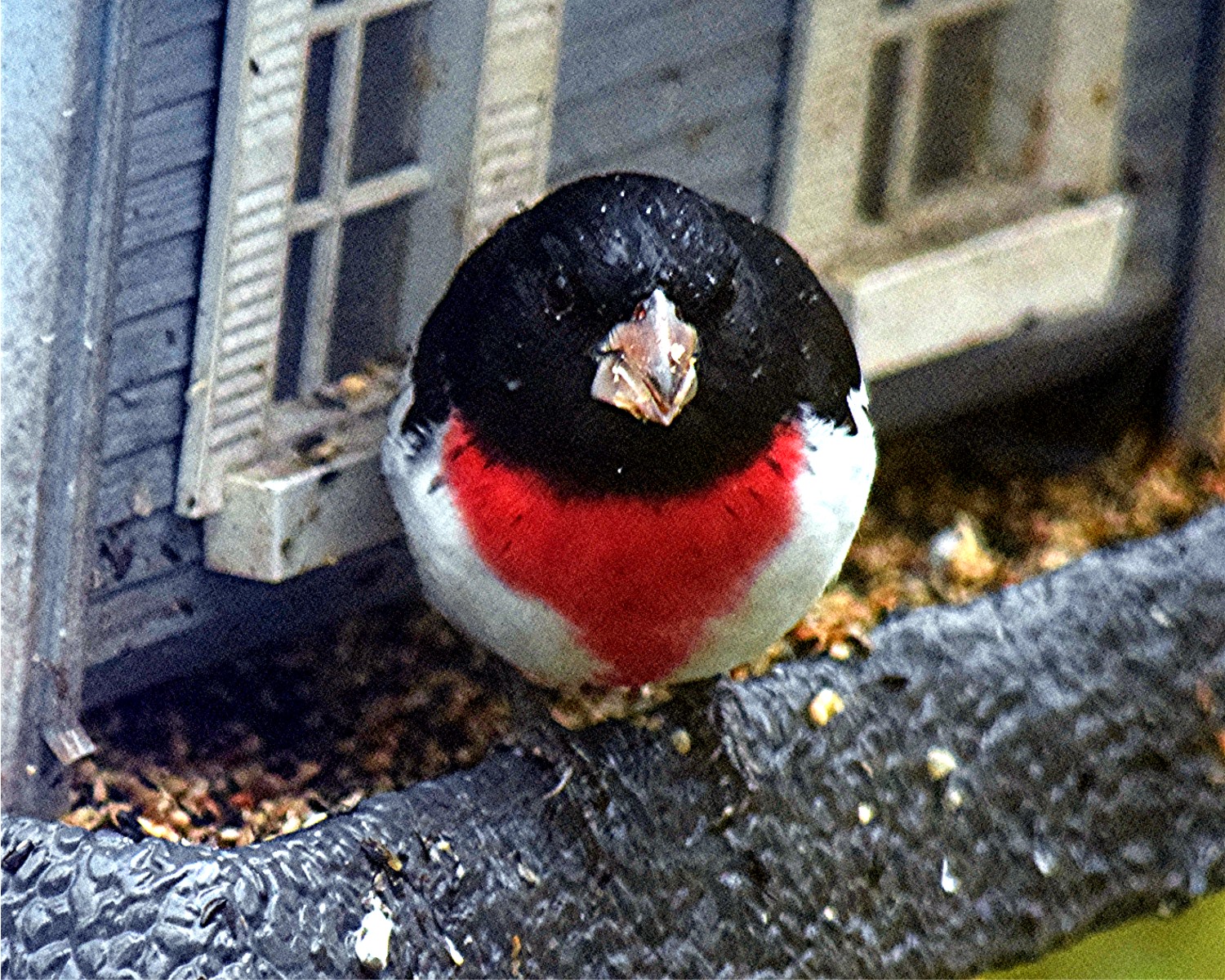
R is for Rose-breasted Grosbeak

Each spring I eagerly anticipate the arrival of a Rose-breasted Grosbeak!
Yesterday I caught a glimpse of my anticipation among the newly opened foliage of our bird feeder area, known to us as Bird Alley.
                                         Its breast color is an unmistakeable eye-catching stand out!!
                                               I didn't have to wait long until it found a feeder. Unfortunately it did not contain any black oiled sunflower seeds which seams to be a food favourite of its.
                                            However the finch food in this feeder seemed to satisfy its taste!

This morning I have used lots of sunflower seeds in our feeders to welcome the return of this bird today when and if it reappears!

Tuesday, May 09, 2017

Pine Warbler

I have never seen a warbler feeding at a bird feeder, that is until yesterday when I captured this

picture of a Pine Warbler feeding in our cage feeder! The white wing tips and the yellow eye ring easily identify this bird as a Pine Warbler.

In the photo above the warbler is down  at the bottom of the feeder where it is easier to get a peanut!

From the discussion with other birders after posting this photo I have learned that a Pine Warbler will feed on peanuts, suet and peanut butter.  There were many peanuts in the feeder yesterday so that most possibly have been the explanation as to why this warbler was within our cage feeder.
It was an  unusual sighting to me and certainly an educational one for sure

Monday, May 08, 2017

Yellow Legs

Although I had seen these Yellow Legs about a week ago I am just getting around to post them now. There were several of them in a flooded area just off the highway in Hoyt , just past the highway bridge.

After studying these photos I have concluded that the Yellow Legs shown directly above is a Lesser Yellow Legs. I would expect to see a slight upturn to its bill if it were a Greater Yellow legs, and the bill looks very straight to me. Also the area around the neck is lighter than that seen on a Greater Yellow Legs would be.


Dog-toothed Violet

                                                       Versatile Naming
                                          Features lending naming clues,
                                                Which preferred by you?

My preference is from my childhood naming choice, that being a Dog-toothed Violet, this naming taken from the canine tooth shaped bulb in its root system.  I dug one up once and it was so!
Another name choice is Trout Lily , taking its name from the resemblance of the mottled or spotted leaves to that found on a Trout's back.
The third name I have today is Adder's Tongue, which I used to think was because of the beautiful magenta, tongue shaped stamens. Apparently not so but rather the shape of the emerging leaves from the ground resemble an Adder's Tongue... go figure.

Sunday, May 07, 2017

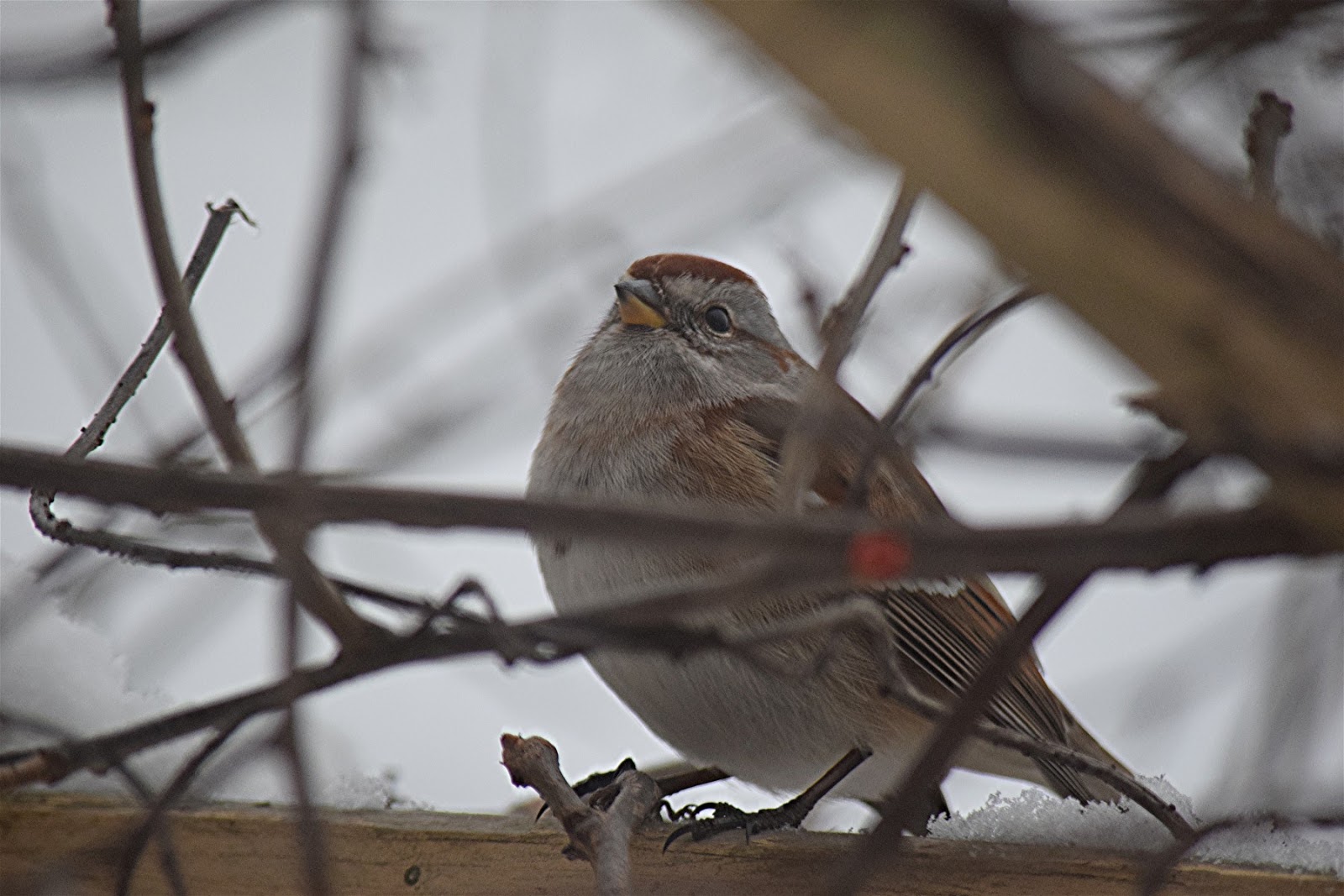
Savannah Sparrow

When I took this sparrow picture I had thought it was a Song Sparrow, seeing that it had a dark breast spot, however for a Song Sparrow the spot was a bit off center.  Hmmmm. then I noticed that the sparrow had yellow lores! A cross between a Song and a Savannah Sparrow??! then I checked my Sibley's bird field guide and surprise to me!, I discovered that Savannahs can also have a dark breast spot!  So hello handsome Savannah, Welcome to Bird Alley!

Wednesday, May 03, 2017

Little Blue Heron

                      seen at Central Blissville NB on May 3rd.,
The Little blue Heron was seen along the edge of the flooded area back near the tree lines and brush. Imagine my surprise when at first I thought that the dark bird I was watching at a distance was not a crow, it wasn't a crow but a Little Blue Heron, a life bird for me!

I have gone to this area several times since but I have not seen the little heron again.

Monday, May 01, 2017

Mayflowers

I discovered a couple of years ago that I did not have to wait until May to find Mayflowers in bloom. Actually around the end of April seems appropriate to find a few in bloom.The Mayflowers in this photo were found on April the 30th . , yesterday. I took these blossoms with a telephoto lense as between me and these flowers was a ditch full of water. I was not prepared to wade across the ditch so just the one photo for today will have to suffice. It is forecast to be rainy for the next couple of days but when the sun shines again I will be heading for the Mayflower patch again with my camera wearing my high rubber boots!
Isnm't it wonderful that the winter is now past and that spring is finally here!

Sunday, April 30, 2017

Indigo Bunting

How exciting it is to see a little blue bird feeding in our feeder area!  We experienced that excitement on Thursday evening when we saw a handsome male Indigo Bunting feeding in Bird Alley!

The next morning the bunting was back again, this time providing a beautiful view for us as it was feeding in a cage feeder hanging just outside our dining room window! 
                    I was very happy to be able to get both a frontal and side view of this handsome bird.
      Today is the fourth day in a row that the bunting is feeding here in Bird Alley, and it has chosen two favourite feeding areas.  One being the cage feeder and the other on the ground under a feeder where bird food has dropped on the ground among some rocks.
 I have checked my records and see that this is the second time we have been visited by a male Indigo Bunting.  Ten years ago in 2007 ,we had our first visit of a Bunting.  In the fall of 2008, we had a female Indigo Bunting stopping by to feed here.
I watch for this little blue bunting each morning and so far I have been rewarded for four days in a row!!  I hope a female might show up to join this little bird

Thursday, March 09, 2017

First duck sighting for 2017

My heart gave a joyful heart leap of 'spring optimism' this morning when I saw this Black Duck in the river as seen from the highway bridge at Hoyt. I was surprised that my first duck sighting of this late winter period was a Black Duck as I usually see Common Goldeneye here or better still Hooded Mergansers. However this assurance this morning that ducks are on their way, tells me that I will soon also be seeing Goldeneye or Megansers too at this location.' "Oh Happy Day"!


Wednesday, March 08, 2017

Red-tailed Hawk

The interesting thing about a Red-tailed Hawk sighting is that I seldom see its red tail.  However on Monday morning of this week I drove to my favourite spring duck sighting area hoping to see a returned Common Goldeneye or perhaps a pair of Hooded Mergansers.  But no ducks in sight; however I did see huge bird in flight. I didn't see any distinctive markings on it but I raised my camera and was able to pan an image of the bird in flight.
When downloading my pictures at home I was very pleased and surprised to see an outstanding  feature of the bird which  led me to making a confident id! You will see what I mean by viewing the photo below!

 I believe the photo above is showing us a Red-tailed Hawk. Do you agree with me? Perhaps I may find it again as it was in the area where I go looking for returned duck migrants every day.

Sunday, February 26, 2017

Finally Snow Buntings

I have  been looking and watching for Snow Buntings all winter and it has been only this week that I have seen a small flock of Snow buntings twice.  When you see a white swirling uplifting from the roadside drifting over a snowy field , you can be quite sure that Yes, you have found Snow Buntings, such as was my experience on Friday.  It was not possible to get a photo mid-air but as the birds landed on a tree and perched on its branches. I was fortunate in being able to document my sighting!


Tuesday, January 03, 2017

Saturday, December 03, 2016

Cedar Waxwing for Saturday Critters

On Wednesday of this week we had our first snowstorm and also a large flock of Cedar Waxwings.  there would have bee over 100 waxwings  They flew from a three point feeding station area.  First to a flowering crab-apple tree to the side corner of our lawn, then to the top of our bower which was covered with rosehips and then into Bid Alley where we have another flowering crab-apple tree covered with small tiny, crab-apple and then they would take a rest in their foraging by landing en masse in our old Maples along our driveway.  As it was snowing and I hadn't yet gotten out my winter boots I did't go out top try for better pictures but just keep watch out of our windows.  It was lovely!

I am linking today with Eileen's Saturday Critters at http://viewingnaturewitheileen.blogspot.ca/
Have a wonderful Saturday everyone. Ann

Wednesday, November 23, 2016

White-breasted Nuthatch

 This beautiful little Nuthatch is a daily visitor feeding daily on our peanut feeders.

Saturday, October 29, 2016

Robin

The Robin in this picture is considering the possible feast before it.  The red looking  like berries are actually Rose Hips.  A few summers ago a wild tiny white Rose started growing over our bower. ever since then Robins find this feasting site at this time every fall and fill up on the Rose Hip

s there. They  also provide a feast for Cedar Waxwings.  Before the fall is over the vines and bushes  will be stripped of these tasty delights.