Friday, February 15, 2008

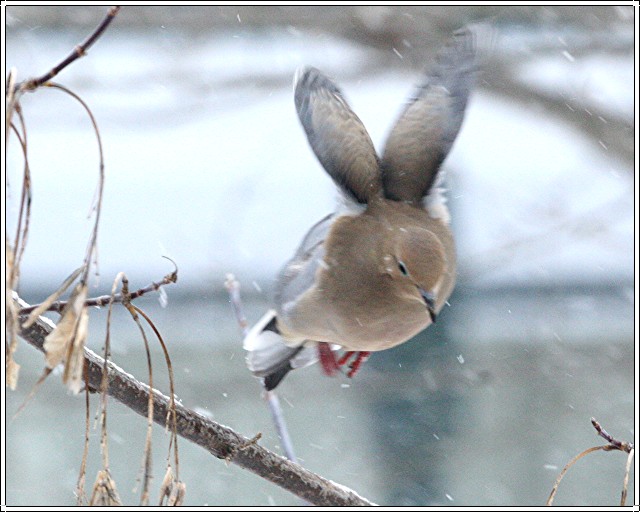
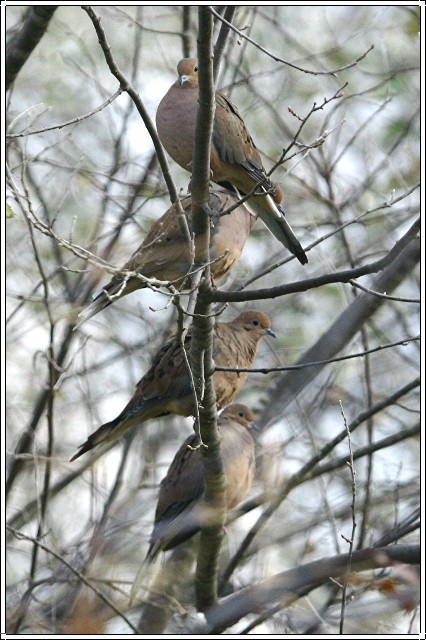
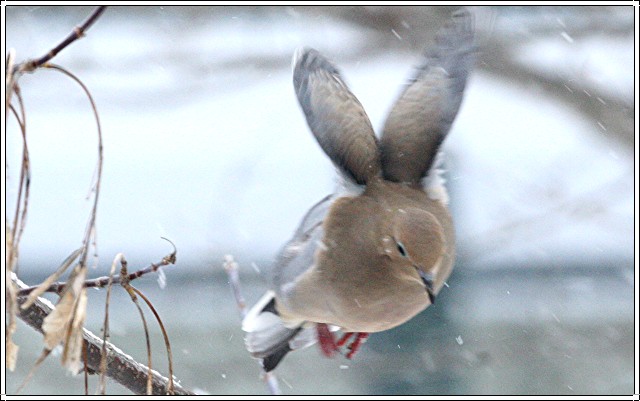
Mourning Doves


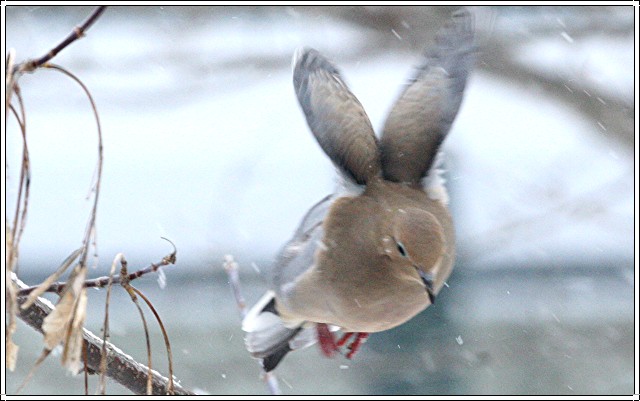
Before I started to really take note of birds, or to take the time to use a field guide, I thought the spelling of this dove's name was, Morning Dove, for that is what I had heard people call them. Then one day while outdoors in my yard, I kept hearing their soft, repetitive, cooing sounds and I suddenly understood their name; Mourning Doves! It has only been the last few decades that Mourning Doves have become such a common all year round sight in our area. In past years their numbers were often an many as 29 or more in our feeder area, but this year I only count them in single digit numbers.

Thursday, February 14, 2008

On this Valentine's Day, following the 15th major winter storm to have hit the Maritimes this winter season, it seems appropriate to post a message of optimism and faith, that; "Yes!", spring is on the way, hopefully just around the corner! At the beginning of each winter season I remind myself of Percy Bysshe Shelley's consoling closing line from his, Ode to the West Wind.

"If winter comes, can Spring be far behind?"


"If you keep a green bough in your heart,
the singing bird will come"
.
- an ancient Chinese proverb

Wednesday, February 13, 2008

Juncos: little snowbirds

They arrived this morning, with the falling snow and the gray dawn; just before full light. There were only two of them and when I returned to the window with a cup of tea, they were gone. I hadn't known that these little Slate-coloured Juncos are often referred to as . 'snow -birds', but after having seen the mention of this nickname in a birding book this morning, with further research I came across that label being used often in reference to them. For, as these two little birds did this morning; juncos often arrive with the snow.

Its interesting to think on what sometimes conjures up a nickname, for I often find myself being reminded of these little Slate-coloured Juncos when I empty the fliter from my clothes dryer. The grey fluff that I hold in my hand causes me to think of these little, fluffy looking, slate-grey birds. But I think 'snowbird', is a much nicer appellation than; 'dryer fluff' birds.
A Slate-coloured Junco, from my picture archives: 2006

Tuesday, February 12, 2008

Searching for Colour


A Snowy Day Haiku
.
drifting swirling snow

tranforming winter landscapes

with wind carved sculpture
We have become so acclimatized to our snowy, white, winter world this year that other than the colourful red of the Cardinals, the blue of the Blue Jays, the yellows and reds of the Pine and Evening Grosbeaks, and the little Redpolls and others, our natural world seems to have become devoid of colour.So when out walking the other day I went searching for colour and here is what I found. One, just one, red apple left on an old, wild Apple Tree growing on the side of the river bank. A winter treat of American Bittersweet Berries still lingering on, perhaps waiting for some Waxwings to find a delightful treat. I also saw the promise of spring exposed in this branch cutting from an old tree; showing its warmth and life from colour within.

I found the presence of winter, the remembrance of fall and the promise of spring.

Monday, February 11, 2008

What a Gaggle!

Ducks, ducks every -where, and they were looking for handouts. These over- wintering Mallards and Black Ducks at Lily Lake were easy subjects to photograph as they approached my car hoping I had food to offer.


Hungry Duck Haiku

hungry hopeful ducks

suddenly unleashed motion

a stale bread banquet

Sunday, February 10, 2008

Evening Grosbeaks


You just know when some birds are around by hearing their call; like the Chickadee, Blue Jay, White-throated Sparrow or the raspy "caw" of a Crow, but I don't recall the sound of an Evening Grosbeak; I don't even know what it sounds like. But there is no mistaking its presence when this large, brightly coloured grosbeak is around; for its colourful pattern immediately grabs your attention. The female Evening Grosbeak is much more subdued in her gray and white sombre tones. Not everyone would call the male handsome, but definitely attractive; yes. They usually arrive in groups and the sunflower seeds can disappear amazingly fast. We have quite a large number of Evening Grosbeaks around our feeder area this week and they are a very welcome addition.

Saturday, February 09, 2008

Early Morning Visitor


While making myself an early morning cup of tea, I was wondering to myself what I would blog today. Noticing movement outside the window as I was going to my computer, I glanced out and there stood the answer to my ponderings! The deer was beautiful as it stood highlighted under the streetlight in the newly fallen snow; however its actions weren't, for it was having an early morning snack from one of my ornamental Junipers! .
.
However, not being one to miss an opportunity, I hurried to get my camera rather than shoooing it away. It knew I was there for it glanced my way before lowering its head to resume its breakfast. Then with a second thought it quickly bounded away around the corner of my house.

Friday, February 08, 2008

Crows


A visit to the coast yesterday, at Saints Rest Marsh, yielded only a few photos of Crows and some gull sightings. Having often said to myself all winter long, when in hopes that it might be a hawk perched near the top of the tree just ahead; "Oh, just another Crow!" I almost said that yesterday, but somehow I found these large passerine birds rather attractive in this snowy, sandy setting admid the sparse marsh grass growing there.
The Bay of Fundy at Saints Rest Marsh, Saint John.

Thursday, February 07, 2008

Counting Redpolls

We have had a lot of Redpolls visiting our feeders this year and when a huge flock arrives I often think to myself, ".. there must be at least a million!" An exaggeration? Well, definitely yes; but the numbers of birds does seem that impressive at times. The other day I took a photo of a small group that had landed in our tall Silver Maple Tree and then tried to count them. I am very bad at estimating numbers in groups and have a tendency to err on the side of less, rather than more.

How many Redpolls were in the group? To get an accurate count I printed off the picture and then grouped the bunches as I counted. How close was your estimate? There were 90 Redpolls in all. This is a counting method that works best for me.

Wednesday, February 06, 2008

Portrait of a Gray Squirrel


This Gray Squirrel, shown above, looks really cute, and I know it gets hungry too; but sometimes I wish it wasn't at my bird feeders eating up the bird food. Its only recently that we have had two showing up quite frequently. Most days it is just the little Red Squirrles; which have been visiting our feeder area for most of the winter. The Gray Squirrel is the largest tree squirrel found in New Brunswick. A size comparision of the Red and Gray Squirrel can be seen in the photo above, which shows both squirrel species feeding at our feeders, doubledecker style. This photo of both the Red and Gray Squirrel is one of my favourites and was taken in June, 2007.
A Gray Squirrel

Tuesday, February 05, 2008

Oh Dear! Be Careful Crossing the Road!


This is becoming a frequent sighting for me at this time of year: a White-tailed Deer crossing the highway. I was only a few kilometers from home yesterday, on my way to the city for the day, when I saw this deer standing to the left of the highway. I knew it was going to cross and I pulled over onto the shoulder of the road to let it do so safely. Just the day before I had been driving along a woods area when I had seen another deer crossing the road there.
Oh dear! Be careful out there, Deer!
...
If you wish to view other photos and posts of White-tailed Deer, please use the "search blog" option at the top, upper left of this page. When doing a search using the word, deer, 19 previous posts on White-tailed Deer can be viewed.

Monday, February 04, 2008

Gray Jay, aka: Canada Jay

This gray and white bird, one of the smallest
jays, is a bird found in our coniferous forests all year round. I see it most frequently in the wintertime when I am driving through wooded roads, and often observe it flying from one side of the road to the other. In my research this morning I was surprised to learn that this species will soon be at work nest building. The Gray Jay will build a new nest in February or early March over a three week period. After its completion the female will lay from two to five pale, green, speckled eggs and then sit upon them, sometimes in snow covered surroundings.

A bird of many names, this Gray Jay also is known as the Whiskey Jack, a Canada Jay, and Camp Robber. The name 'Camp Robber', being derived from its habit of hanging around wood's camps and helping itself to any available food it might find there. Here in New Brunswick this jay is commonly referred to as a Gorby or Moosebird.

To view more photos of a Gray Jay please use the search blank located at the upper left of this page. By entering the name,' Gray Jay' in the space provided, you will locate other postings of this bird.

Sunday, February 03, 2008

A Lurking Hawk

Rooted in our neigh -bour's yard, with its over- hanging branches spreading over mine; this old, tall Pine provides both sanctuary and shelter for many small birds. For the Sharp-shinned Hawk it provides secrecy and opportunism, for I have seen it there, hidden amongst the Pine's branches; its stealthy presence lurking in wait of prey. It seemed to be around for a large portion of the day yesterday and at one point left the secluded shadows of the Pine and perched in the open, upon a bare branch of our High Bush Cranberry. There were few birds about yesterday and the hawk was not successful in its wait, at least not while I watched. I have not refilled our feeders these past few days in hopes of discouraging small birds, so as not to have them become unsuspecting prey. Also it was a day of rain and ice and wind; not a nice day to be out and about. At one point I made a short video clip of the wind moving the icy branches, while the hawk sat upon its perch in the background.

Friday, February 01, 2008

Black-capped Chickadee - Provincial Bird of NB


There is a bird, very similar looking to the Black-capped Chickadee, found in England called the Marsh Tit. Readers may find it interesting to click on this link to Kingsdowner blog and view pictures of two different birds there; the Coal Tit and the Marsh Tit, both of which bear a similar likeness to the Black-capped Chickadee.

This English Blogger presents lovely and interesting bird photos, many of which I am not familiar with, accompained by informative commentary. As well, very enjoyable photos of the beautiful English country side and natural history of the region around Kent are presented.