Sunday, July 22, 2007

Catbird

I think we have Catbirds nesting in our yard. We often see them around and when our old, very tall, and dense Wild Rose Bush was in bloom we saw a couple checking it out and since then we often see them around the fringe of our yard. Its either in the Rose Bushes or else in an Apple Tree adjacent to our neighbour's woodpile where their nest is located. I shall check for the old nest in the fall. One year a Catbird pair nested in our wild Rose Bush and it was a delight to hear and see them perched on our fence casting their "meows" about our backyard. The Catbird seen here is perched on our neighbour's woodpile.

Saturday, July 21, 2007

Philadelphia Vireo

Pictured here today is a new feathered visitor to my yard list as well as being a new addition to my life list: a Philadelphia Vireo. This is the first vireo I have seen. This was a more difficult one for me to identify and I was looking in the warbler pages of my field guide book at first. However, in an old Peterson's field guide (1980 edition), I found mention of a Philadelphia Warbler as being a similar species to an Orange-crowned Warbler. A significant characteristic that convinced me of its id was the dark spot between the eye and bill of this bird.

Friday, July 20, 2007

Baby Warblers: Redstart and Black & White


Sweet, sweet! That's the best description I can think of to give for this young,male Redstart. At first I was confused as to its identify but then after looking at pictures of Redstarts in Bird Field Guides I found that the colours seemed to be in the same place, athough the light yellow tail with the black tip, the orange on its the sides, and the black facial markings didn't seem to match either a female or male Redstart in the pictures shown in the bird guide books that I had. Later in the evening I managed to click another picture of another Redstart, and although it is not sharp in detail the markings are somewhat similar to those of the bird in the first photo. The bird shown in this second picture seems to be in a more mature stage of development than the first bird shown and it was looking more like a Redstart. What do you think? Picture below added July 21st.
The second young warbler species shown is a Black and White Warbler. This little warbler did not give as much confusion to its idenity as did the Redstart initially. When it leaned forward the characteristic black and white striping on its head was easily seen.

Thursday, July 19, 2007

Male Bobolink in a Meadow


Wednesday, July 18, 2007

Primrose Moth [Schinia florida]

My memories of moths during my childhood years were those of grey, dingy, unwanted things associated with the smell of moth balls. However as my horizons expanded I have encounted many beautiful winged creatures and I find a delight in their beauty. One such moth is the Primrose Moth. I recall an early evening in July, 2004, when out on a walk along a trail I spied from a distance what I thought was a new wildflower; a beautiful yellow one with a pink and white center. Upon closer inspection however I discovered a pink and white moth, a Primrose Moth, nestled in the center of a Common Evening Primrose. Since that time I frequently stop and check out these wildflowers (Evening Primrose) when they come into bloom during July and often can find one or two; or sometimes even three Primrose Moths on the same plant, as is shown in the photo above.

Tuesday, July 17, 2007

Monday, July 16, 2007

Monarchs, Northern Harrier, Eastern Phoebe

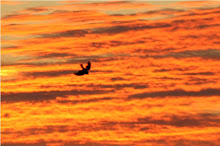
Yesterday, hoping to find Monarch butterflies, I decided to check out a Milkweed Patch a few miles away where I had found Monarchs last summer. En route, while passing a large meadow along the way, I saw an adult male Northern Harrier coursing the area and got a distant photo of it before it flew from view. Arriving at the Milkweed Patch I found two beautiful Monarchs. the photo of the one shown above is a male Monarch. Perhaps I shall return there today and search for signs of eggs or caterpillars. Last year I raised a Monarch Caterpillar and was able to observe it change into a beautiful adult butterfly. On the gravelled shoulder of the road nearby I saw a very vibrant, yellow, Orange Sulphur Butterfly and patiently waited for it to settle so as to get its picture. Before returning home I drove to a small lake in the vicinity and just as I stopped my car I saw an Osprey plunge into its waters. Not having my camera ready I watched while it rose from the water, unsuccess -ful in its hunt. Perched in a group of Birches over the water was an Eastern Phoebe and on some hummocks of grass in the low waters near the shore I caught a glimpse of a few gleaming domes of Painted Turtles basking in the sun. All enjoyable sightings.

Friday, July 13, 2007

Striped Hairstreak

While standing in my yard taking pictures of baby Tree Swallows in their birdhouse above I caught a glimpse of a small dark butterfly in the Ninebark bush beside me. My first sighting ever of a Striped Hairstreak.

Thursday, July 12, 2007

Still Here, Still Hungry


EDITING NOTE: The baby Tree Swallows left the birdhouse sometime on Friday, July 13th.

Wednesday, July 11, 2007

Baby Tree Swallows Still Here

There are still at least two baby Tree Swallows still left in our bird house and perhaps more. As you can see by the size of this one pushing its body out of the entrance hole while waiting for the adult bird to return with food; there would be little room to see more baby birds at the same time. As soon as the baby bird saw the adult Tree Sparrow approaching it opened its
mouth wide in anticipation.

Monday, July 09, 2007

Baby Tree Swallows


Our Tree Swallow bird house has been a scene of activity this weekend as the growing demands of the baby birds have kept the adult Tree Swallows busy tending to their needs . The baby birds will soon become fledglings leaving their nest. It could happen any day now.

Saturday, July 07, 2007

Spotted Tussock Moth and Caterpillar

Last week I had found a Rosy Maple Moth at a gas station near by. This week I found a Spotted Tussock Moth there. This very pretty yellow moth also has an attractive looking caterpillar within its life cycle. I found a picture of a Spotted Tussock Moth Cater- pillar in my picture archives which I had taken in August 2001. To view more photos of moths and butterflies go to:
http://butterflies-seen.blogspot.com

Thursday, July 05, 2007

American Copper, Fritillaries, Red Admiral and Pearly-eye

American Copper
Aphrodite Fritillary
Northern Pearly-eye
Red Admiral
Great Spangled Fritillary

Wednesday, July 04, 2007

Osprey Again

Tuesday, July 03, 2007

Broad-winged Hawk

While driving along hwy #7 this morning nearing Oromocto, about 1 or 2 km from where the #7 meets the Trans-Canada we saw a hawk fly across the highway above us. Rather curious as to what it was we pulled over onto the shoulder and got out of our car; me with my camera and my spouse with the binoculars. I was surprised, and also delighted, that it circled above a few times just slightly to our right. As we watched I was able to get some underbody photos of it as it circled. The sun was bright and I couldn't get a lot of detail but the best thing about the photos was its undertail white band for this is what helped me with the id of it. The underneath markings of this hawk match up with those of a Dark adult Broad-winged Hawk on p.118 of David Sibley's, The Sibley Guide to Birds, 2000. Without this view I don't think I would have been able to id this bueto. This was a rather special sighting for me as I don't recall having made an id of a Broad-winged Hawk before.

Monday, July 02, 2007

Great Blue Heron Fishing

Assimilating the patience of a Great Blue Heron I stood on an observation deck on the other side of the river and waited and watched while this heron caught three fish. At first its movements were slow and deliberate; then with a quick, sudden move its patience was rewarded with a successful catch; and my reward was documenting this action sequence.


Saturday, June 30, 2007

Rosy Maple Moth

I had only seen this moth species once before and that was in the early 2000's when I had found one clinging on my screen door one morning. This weekend we had stopped at a gas station and found several Rosy Maple Moths on the outside wall of the building there . A welcomed sighting of a very colourful moth.

Friday, June 29, 2007

Flies and Bugs

I take a walk through a meadow often for it is a most fascinating place full of wildflowers, butterfies and moths, dragonflies and damselflies and bugs and beetles. The small flying creature pictured to the left mimics the appearance of a bee or wasp but is actually a fly called American Hover Fly. This fly feeds on flower nectar and also aphids. The colourful black and orange/red beetle to the right is called a Burying Beetle and as its name implies buries carrion that it encounters. Insects and bugs are all fascinating to look at and photograph and research. A meadow is wonderful place to wander through for you may find all sorts of small intriguing creatures there.

Thursday, June 28, 2007

Round-leaved Sundew

This was a new find for me. A very small plant that is know for growing in boggy areas, yet I found this growing on an eroded hillside while looking for butterflies in the dry, sparse, grassy area above. I think there is probably underground water seepage that keeps the area wet and damp at the spot where this Round-leaved Sundew is located. It was not in blossom yet but the tall stem, which is cane-shaped at its top, holds the buds that will come into blossom one at a time. As a child I remember being fascinated when hearing of carnivorous plants. Imagine a plant eating an insect! Even today I am still intrigued by Pitcher Plants whenever I find them. So I was doubly impressed to learn that Sundew is also a carnivorous plant. I didn't see the clear, sticky, liquid droplets on the end of the plant's spines that look like 'dew' until I downloaded my macro photos. Insects flying by will get stuck in this sticky substance and the Sundew plant will gradually dissolve and absorb the nutrients from the trapped insect's body.

.